Are We All Just Button-Pressers Now?
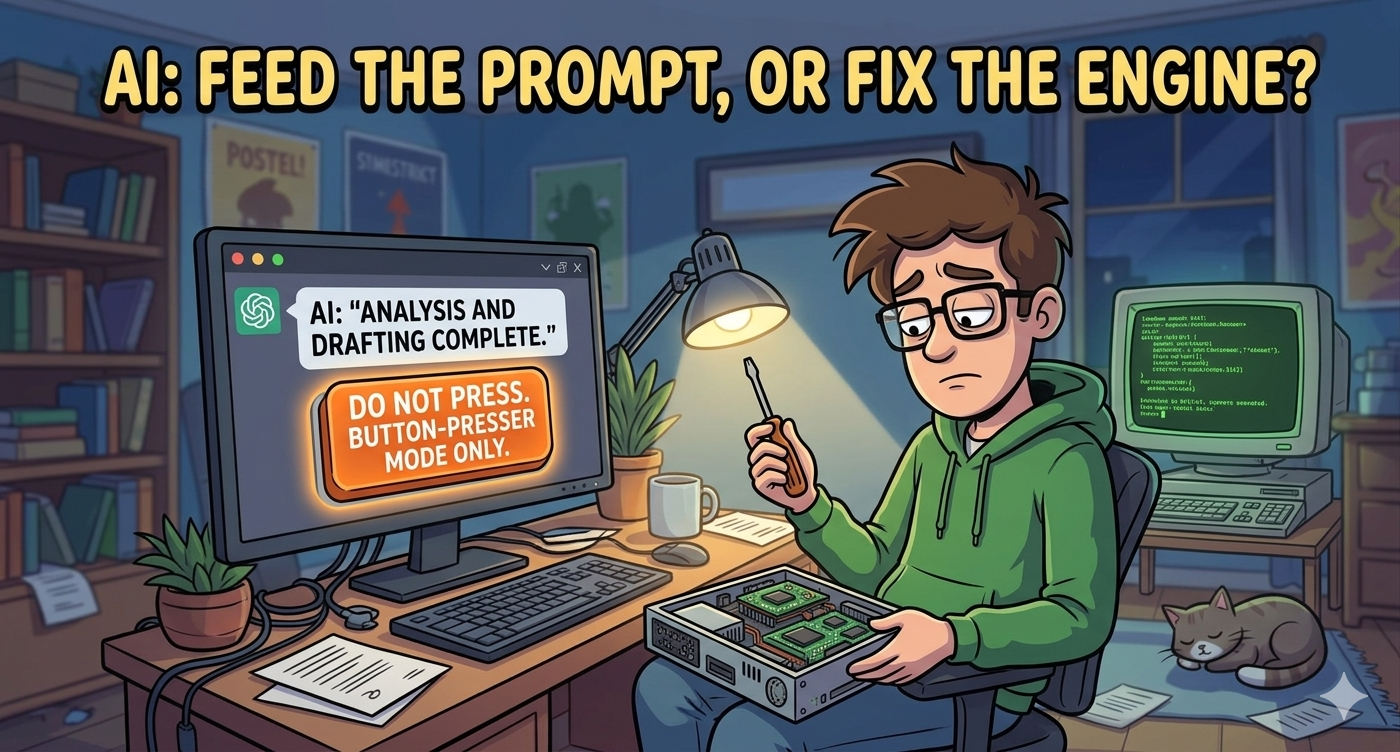
There is a conversation I keep having – with colleagues, with people in similar roles, occasionally just with myself at half eleven at night when I probably should have gone to bed an hour ago. It goes something like this: if AI can do the job well enough, what exactly are we for?
I am not asking that in a panicked, existential way. I am asking it as someone who has watched IT go through enough cycles of disruption to know that ‘the humans are fine’ isn’t always the punchline to that joke. I have been thinking about it more since reading about the commoditisation of expertise, which puts into words something that has been nagging at me.
The argument is this: as businesses push AI into every corner of their operations, the human role doesn’t get elevated – it gets flattened. Instead of specialists with hard-won knowledge, you end up with a workforce of people whose primary function is feeding prompts into a box and checking the output isn’t obviously wrong. It is the ‘button-presser’ paradigm.
What really lands for me is the comparison to the outsourcing wave of the early 2000s. Businesses realised that if you standardised a process enough, it didn’t matter where it was done – you could ship it to wherever labour was cheapest. AI is doing the same thing, except the ‘offshore’ destination is an algorithm. And an algorithm doesn’t ask for a pay rise or go on holiday.
But here is the bit that deserves more attention: the experience gap. If junior staff never do the foundational work – the messy, slow, occasionally humiliating process of actually learning something – they don’t build the instincts that make a senior person worth having. In infrastructure, you can follow a runbook, sure, but the person who has watched three different systems fall over in three different ways at two in the morning? They know things a runbook doesn’t cover. That knowledge comes from doing the thing, badly, until you do it properly.
If AI handles the analysis, the drafting, and the initial coding, where does the next generation of experts come from? You cannot shortcut your way to mastery.
I don’t think AI will simply eat all the jobs. But there is a real risk that businesses hollow out the expertise that makes their operations resilient. Then, when something genuinely complicated goes wrong, there is nobody left who actually knows what to do.
If you are early in your career, my advice is: resist the temptation to let the tools do all the thinking. Use them, but ensure you still understand what is happening under the bonnet. Because the day the button stops working is the day they will find out whether they have got engineers or just operators.
And those aren’t the same thing.









Post Comment